

Metal Quenching Research Laboratory
Metal Quenching Research Laboratory
Lab In-Charge: Dr.-Ing. Ashok Kumar Nallathambi
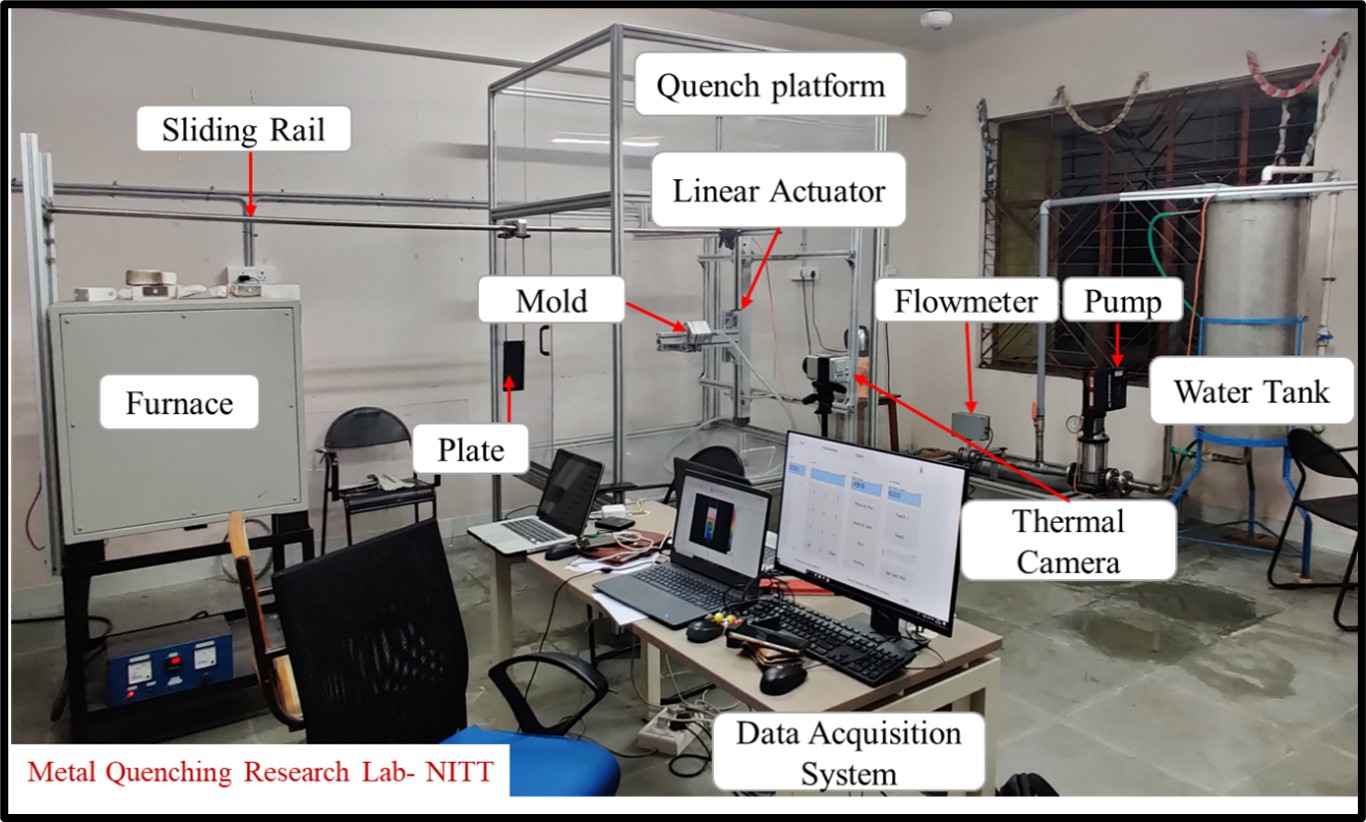
We do quenching heat transfer experiments. We measure thermal field using Infrared camera. Mostly, we focus on hot cracks which arises during metal solidification. In the mushy state, very narrow temperature interval in between solidus and liquidus temperature, most of the alloys undergo ductile to brittle transition. This valnerable window opens the possibility of occurs of hot cracks. We dedicate our research to understand the mechanism of hot tear origination and propagation.
Equipment List / Details:
- Infrared Therocam VarioCam HD Head 700 - Measurement upto 900 degC - 60Hz, 640x480 Resolution - To measure the time and space dependent temperature profile
-
Variable Speed Pump (Grundfos) - Max flow rate 3 cu.meter per hour, 52m head - To supply water at high pressure & constant flow rate
-
Moving Mold Mechanism – LES 4 Linear drive ( ISEL GmbH) - 0.1 mm accurate positioning, max speed 90 mm/s, 900 mm travel distance - To move the water mold at required speed
-
Electromagnetic Flowmeter (FLOWTECH) - 5-50 Liter/min, 25 bar, 15 mm diameter - To measure water flow rate
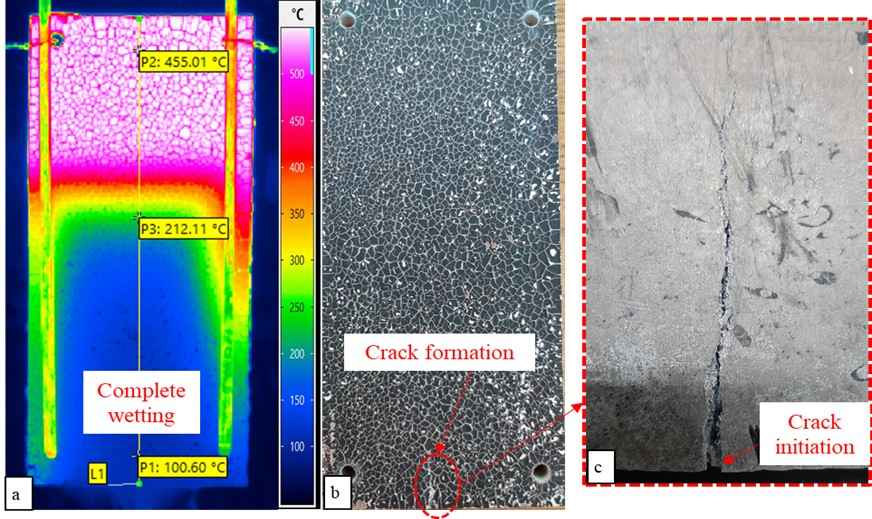
Experimental observation of AA7075 plate: (a) IR image, (b) and (c) Quench crack
List of experiments:
- Measurement of temperature profile during quenching
- Rewetting effect on solid and semi-solid plates
- Observation of Water Ejection and propagation of wetting front effects
- Observation of Crack initiation and propagation
PhD Scholar: Mr. Abiraham F - Current Student
Associated Scientist: Dr. Saravanakumar P